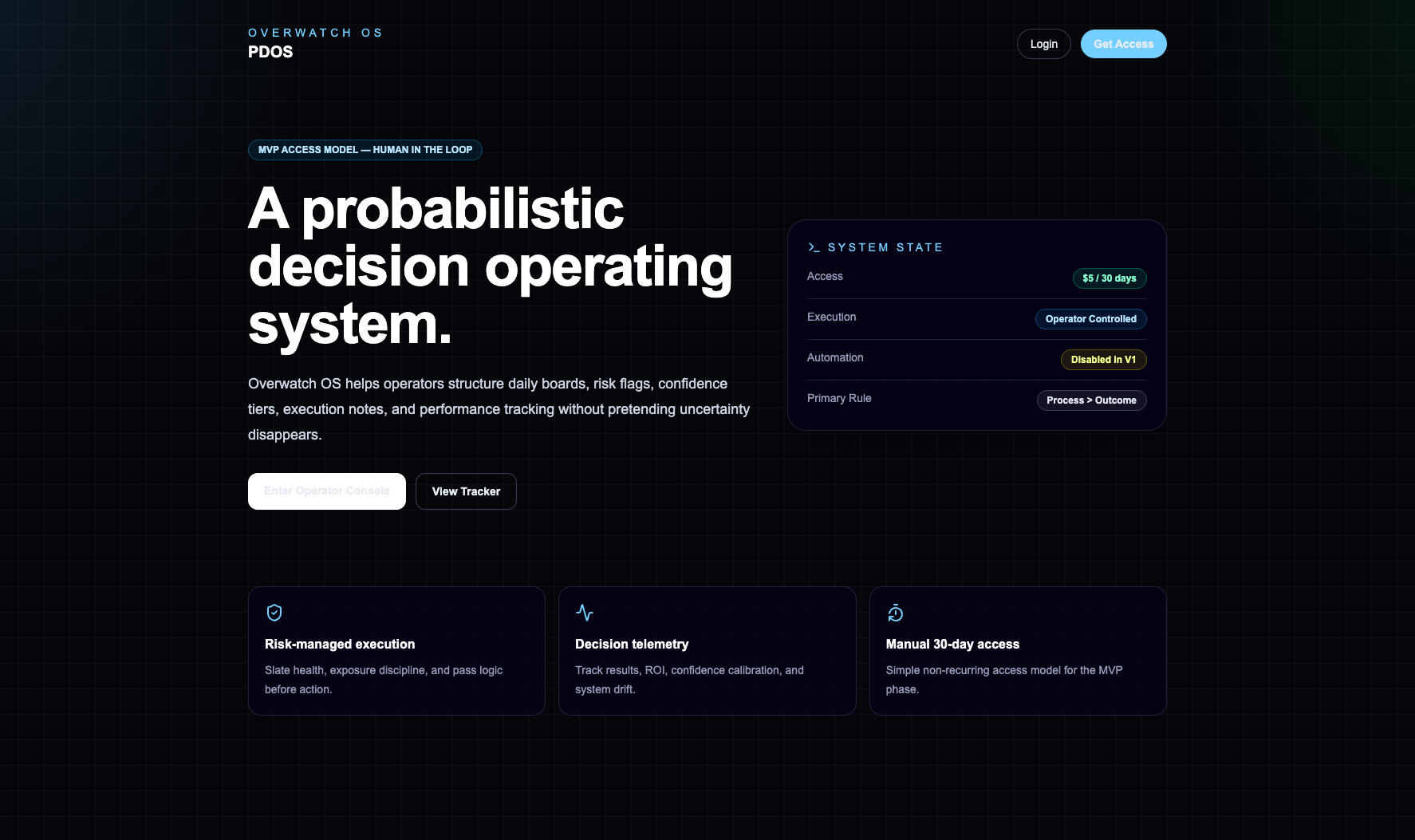
Deploying Overwatch OS — Entering the QA Phase
Over the past several months, I’ve been building something that started as a simple question:
What if decision-making itself could become a structured operating system?
Today marks a major milestone in that process.
Overwatch OS has officially entered the QA / Alpha testing phase.
The first live operational build is now deployed publicly with:
- Production hosting
- Authentication infrastructure
- Protected application routes
- Dashboard architecture
- Tracker systems
- Admin framework
- Initial user testing workflows
This is no longer just a concept document or workflow diagram.
It’s now an active software platform.
What Overwatch OS Actually Is
At its core, Overwatch OS is a Probabilistic Decision Operating System (PDOS).
The platform is designed around a simple idea:
Modern decision-making is fragmented.
People operate across:
- incomplete information
- emotional bias
- inconsistent execution
- poor tracking
- reactive workflows
Overwatch OS is being built to structure that process into a repeatable system.
The project combines:
- Human operator oversight
- AI-assisted analysis
- Risk management frameworks
- Verification systems
- Data tracking pipelines
- Calibration feedback loops
The result is a platform focused on:
➡️ Structured execution
➡️ Probabilistic thinking
➡️ Risk-adjusted decision workflows
➡️ Long-term process optimization
While the initial implementation focuses on sports analytics and probabilistic modeling, the larger architecture extends far beyond a single domain.
The underlying framework applies to:
- analytics workflows
- operational systems
- forecasting
- financial modeling
- project management
- field intelligence
- engineering environments
- future human-AI coordination systems
The Architecture Behind the System
Overwatch OS is being developed more like an operational infrastructure layer than a traditional app.
The current alpha architecture includes:
Frontend Stack
- Next.js
- React
- TailwindCSS
Backend & Infrastructure
- Supabase authentication
- Protected route middleware
- Session persistence
- Vercel deployment pipeline
Current Operational Routes
//login/dashboard/tracker/admin
The current system workflow operates conceptually as:
Operator
↓
Board / Data Input
↓
AI Quant & Risk Layer
↓
Verification Engine
↓
Execution Decision
↓
Tracker Feedback Loop
↓
Calibration & Optimization
The goal is not simply prediction.
The goal is improving the quality and consistency of decision execution over time.
Why the QA Phase Matters
Entering QA is one of the most important transitions in any software project.
It means the system has crossed from:
“idea phase”
into:
“operational software system.”
The current QA process focuses on:
- User authentication testing
- Session persistence
- Protected route validation
- Mobile responsiveness
- User experience refinement
- Workflow clarity
- Stability testing
- Execution reliability
This phase also introduces real-world feedback loops, which are critical for improving the system architecture moving forward.
The first bugs, edge cases, and UX issues are already appearing — which is a good sign.
That means the platform is now mature enough to expose real operational behavior.
Building the System in Public
One of the goals behind Overwatch OS is to build transparently and document the process publicly.
Over the last year, my work has increasingly converged around:
- drone mapping
- VDC workflows
- BIM systems
- analytics
- automation
- operational architecture
- AI-assisted workflows
Overwatch OS represents the convergence of many of those interests into a single evolving platform.
The project is heavily influenced by:
- systems engineering
- probabilistic modeling
- operational discipline
- feedback-loop design
- calibration thinking
- structured execution systems
Rather than treating AI as a replacement for human operators, the goal is to explore how AI can function as a structured analytical layer inside larger operational systems.
Current Sprint Roadmap
The immediate development roadmap includes:
Sprint 1 — Stabilization & UX Polish
- Improved mobile authentication behavior
- Session persistence refinement
- UX clarity improvements
- Navigation polish
- QA logging workflows
Sprint 2 — Tracker Integration
- Entry logging systems
- ROI tracking
- Calibration dashboards
- Historical performance analytics
- Risk exposure monitoring
Sprint 3 — Intelligence Layer Expansion
- Async verification systems
- News & injury validation pipelines
- Automated data auditing
- Probabilistic weighting systems
- Expanded analytics architecture
The Long-Term Vision
Overwatch OS is still extremely early.
But the larger vision is becoming clearer.
The project is evolving toward:
➡️ A structured decision-intelligence platform
➡️ A human + AI operational framework
➡️ A probabilistic workflow environment
➡️ A system focused on calibration over emotion
The real objective is not simply “better picks.”
It’s building systems that improve decision quality over time through:
- feedback
- structure
- analytics
- verification
- discipline
- iteration
Entering the Next Phase
Only a few months ago, this existed primarily as architecture notes, workflow diagrams, and conceptual frameworks.
Today:
- the application is deployed
- the authentication stack is operational
- QA testing has begun
- iterative sprint development is active
The system is now real enough to test, break, improve, and evolve.
And this is only the beginning.
Project: Overwatch OS
Category: SaaS / Decision Systems / AI Infrastructure
Status: Alpha QA Phase